Wellness podcasting sells rebellion against the medical establishment to audiences that establishment could only dream of. Following the money - from ad-reads to equity stakes to a Surgeon General's office - reveals an industry that profits from never curing you.
Be honest. You've dabbled. We all have.
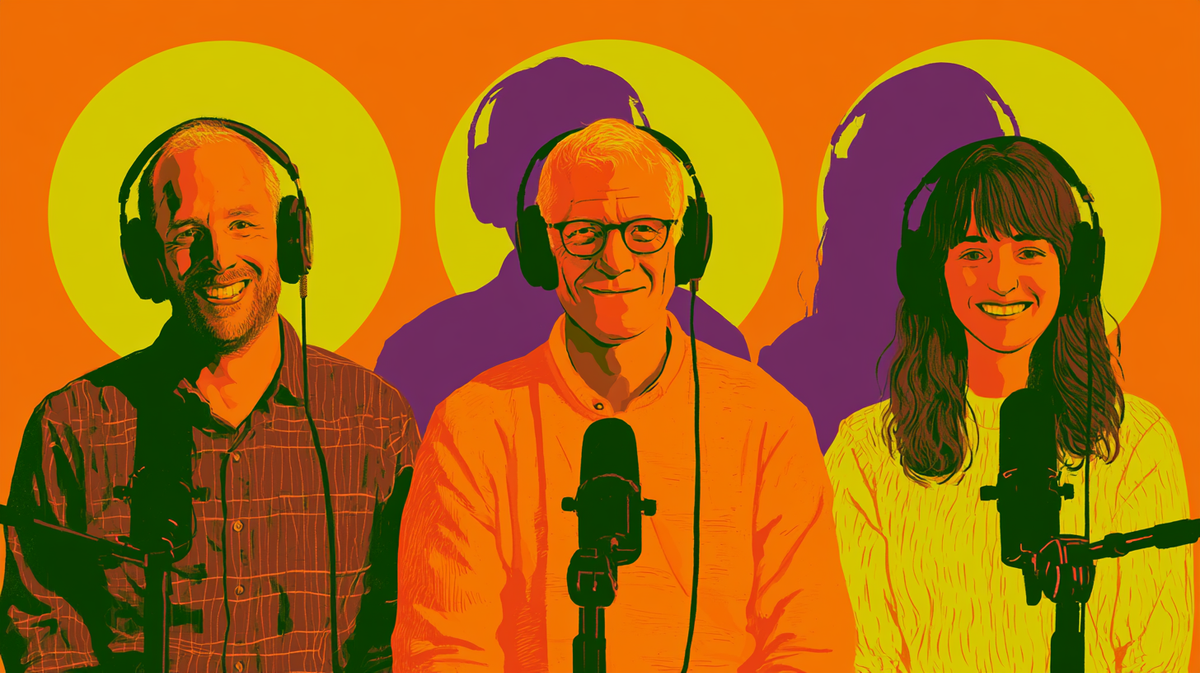
Somewhere in the last year you've had the headphones in, some three-hour conversation playing while you did the washing up, and a man with very good lighting has told you something that rearranged your evening.
It could be Bartlett, leaning in, letting a founder explain why everything you eat is quietly killing you. Or it was Rogan, delighted, discovering on air that sunlight might be a nutrient. Or maybe it was Huberman, calm as a hostage negotiator, explaining why you have been getting mornings wrong your entire life.
And the ideas. Wow. They are glorious, liberating ideas. Seed oils are poisoning you. Your blood sugar is on a rollercoaster and the dip is why you're sad. Sunscreen is the real danger, not the sun. Cholesterol was a lie, breakfast was a marketing campaign, and the reason you're tired, anxious and faintly disappointed in yourself is not the mortgage or the news but a mineral deficiency that - happily - can be corrected for four monthly instalments of £39.
 Matt Hussey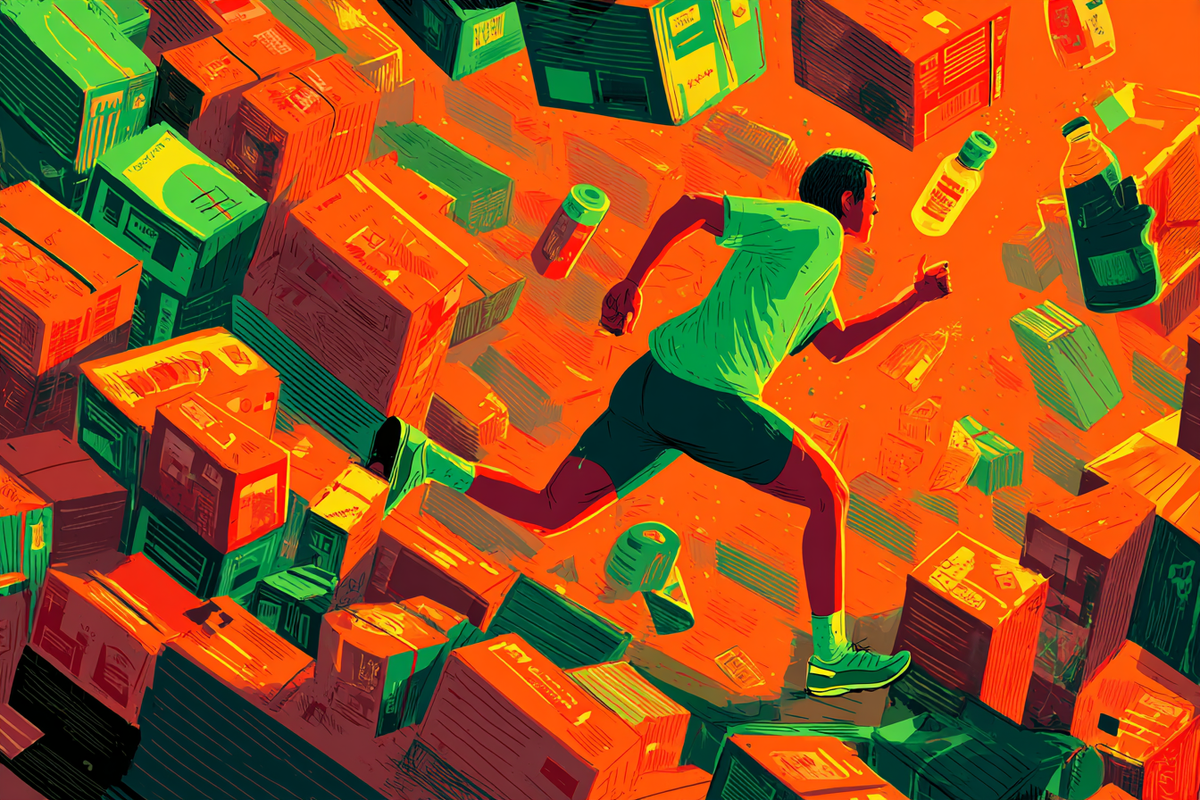
And doesn't it feel like a public service? These fearless trailblazers, broadcasting from their podcast studios, finally saying the things the establishment won't. No pharmaceutical company sponsoring the message. No medical board deciding what you're allowed to know. Just brave, curious people, following the evidence wherever it leads, handing you the truth your doctor was apparently too busy or too bought to mention.
It's a wonderful story. Genuinely. It has heroes, villains, a persecuted truth and a grateful audience of millions. But there's another story I want to tell about these wellness influencers. It's less flattering, and it follows the money rather than the evidence - and once you've seen it, you can't unhear it under the lighting.
The Funder Is Already in the Room
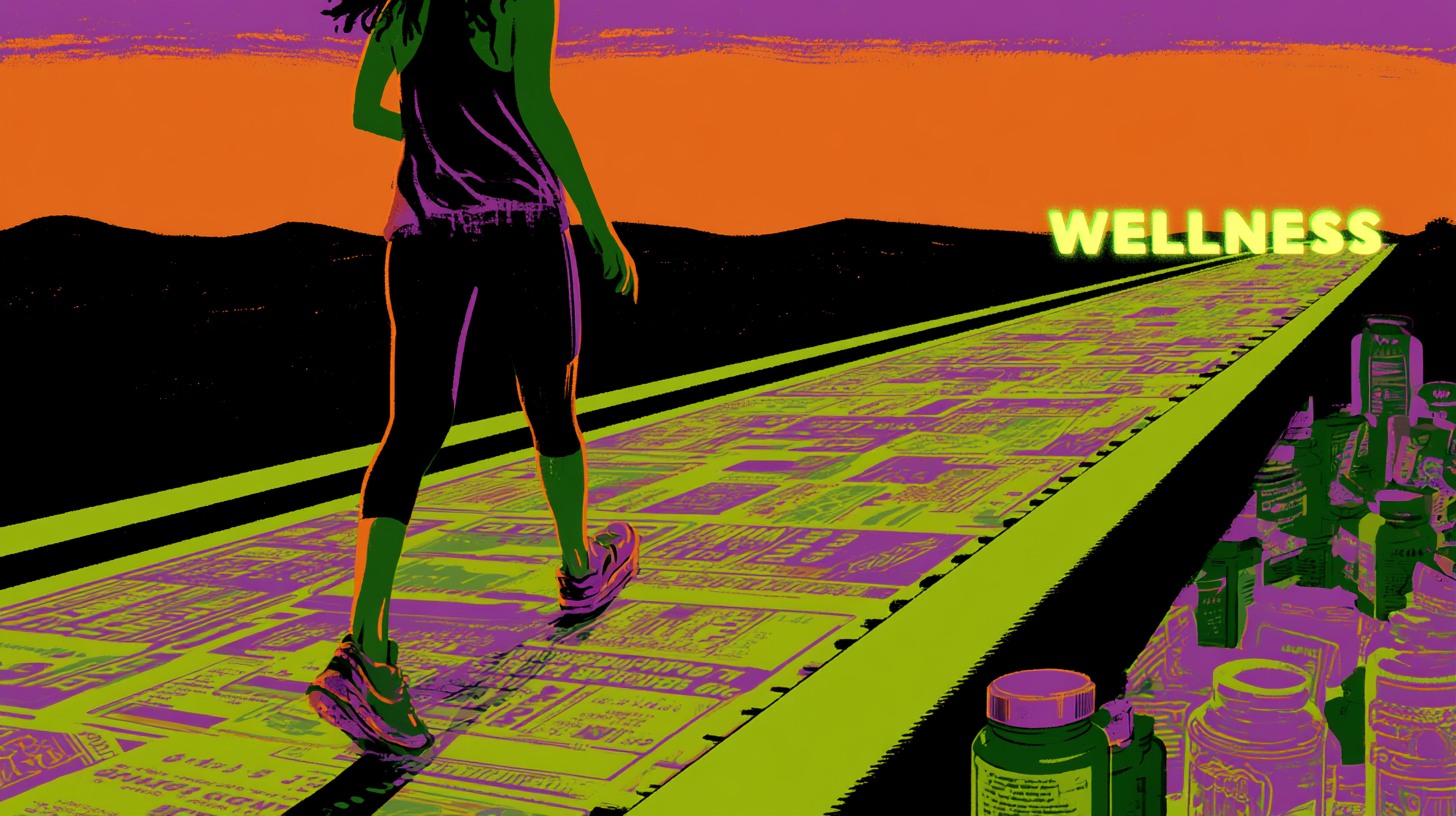
In 2024 we caught a glimpse of how this world worked. You may have missed it. That August, while everyone was on holiday, the Advertising Standards Authority did something a podcast cannot do to itself. It told the truth about the money.
The regulator banned a set of Facebook ads featuring Steven Bartlett - host of The Diary of a CEO, and Huel, the meal-replacement brand, and Zoe, the nutrition-testing company.
It was the silence around the money. Bartlett is a director at Huel and an investor in Zoe, and the ads never said so. The ASA concluded that many viewers would read them as an independent testimonial rather than the words of a man with a financial interest in your decision - and that the omission made them misleading.
That's the whole machine in one ruling. Platform the product. Hold the equity. Say nothing. We have heard this story before, told in a different accent. The same year Bartlett got banned, the US Department of Justice unsealed an indictment describing how two employees of the Russian state broadcaster RT had funnelled nearly $10 million through shell companies to a Tennessee media firm, to put Kremlin-friendly messaging in the mouths of right-wing commentators - some of whom, prosecutors said, had no idea who was really paying them. That scandal needed a foreign government, a fake investor and a laundering operation to get a message onto a microphone.
 Matt Hussey
Wellness needs none of it. There is no Moscow here, no shell company, no cheque to trace across a border. The host owns the supplement. The neuroscientist advises the brand he recommends. The wellness expert runs the company that profits from the policy he has been appointed to wax lyrical about. Nobody is being deceived about the source of the money, because the source of the money is sitting in the chair. The funder is already in the room, holding the microphone.
This is the podcast industrial complex, and it is not, whatever it tells you, a rebellion. It is Maintenance Capitalism in audio form: an industry that profits from managing an anxiety it is structurally incentivised never to resolve. A cured listener stops listening. So nobody is ever cured. There is only the next protocol, the next test, the next episode - and a word, journey, doing the heavy lifting of pretending the destination was ever the point.
This is an industry that sells you rebellion against the establishment, broadcast to audiences the establishment could only dream of reaching. Rogan outdraws the cable networks. Bartlett outdraws the newspapers that fact-check him. The Goliath these voices claim to be slaying is, by every measure of reach and revenue, smaller than they are. They are not the insurgency. They are the incumbent, wearing the outsider's coat - because the coat is what sells the protocol.
It is worth pausing on what the outsider's coat is actually worth, because the numbers do not describe insurgents. They describe an aristocracy.
Joe Rogan's most recent deal with Spotify was reported to be worth up to $250 million - not a salary, a single distribution agreement for a single show, and a step up from a previous deal already estimated north of $200 million.
Steven Bartlett, the British end of the circuit, earned a reported $52 million in a year, which placed him third on Forbes' 2026 list of the highest-paid creators on the planet - behind a man who films himself giving away money, and ahead of almost everyone else alive.
His podcast alone generated $20 million in revenue in 2024 and is projected to clear $30 million; his parent company has been valued at $425 million; and he has, by his own account, turned down network offers in the region of $100 million because he can make more alone. These are not the accounts of people at war with the system. These are the accounts of the system.
And the "free" podcast is not the business - it is the shop window for the business. Bartlett's own studio describes the goal with startling candour: audiences, they say, are looking for "products that can help them implement the changes they want to make."
That is the diagnose-and-sell loop rendered as a mission statement. The episode is not the product you buy. The episode is the thing that convinces you to buy the product - the supplement, the test, the programme, the book, the branded journal - and the more the anxiety compounds across the year, the more product the loop moves.
Now stand back far enough to see the whole floor. The global wellness economy reached $6.8 trillion in 2024, according to the Global Wellness Institute - an industry that has doubled in a decade and is now, by their reckoning, nearly four times the size of the entire pharmaceutical industry. Sit with that.
The great villain of every one of these episodes, Big Pharma, the corrupt colossus keeping you sick for profit - is a quarter the size of the wellness economy waving the accusation. The rebels are not throwing rocks at the castle. They own the larger castle next door, and they have discovered that the most profitable thing you can sell from its walls is a rumour about the smaller one.
This is the anti-establishment paradox in its final form. It was never David and Goliath. It was Goliath in a David costume, because the costume is what shifts the units - and the units, it turns out, run to the trillions. So let's follow the money. Not as an accusation, but as a route. In this essay, that money follows three pathways.
 Matt Hussey
Equity dressed as endorsement
The first is the cleanest, and we have already met it. Call it equity dressed as endorsement. Bartlett is the documented case because a regulator wrote it down, but the form is everywhere: the host platforms a product, holds a stake in the company behind it, and lets the conversation do the advertising an ad break would be obliged to label. It is not lying. It is something more elegant - a structure in which enthusiasm and ownership become impossible to tell apart.
Advisor-sponsor fusion
The second is subtler, and it belongs to the scientists. Call it adviser-sponsor fusion. When Andrew Huberman reads a sponsorship spot for the supplement brand AG1, he is not only its sponsor's host; by his own disclosure he is also a paid scientific adviser to the company - a role AG1 itself announced in 2022.
That's sponsor and authority, collapsed into one voice. The conflict isn't the advert; every podcast has adverts. The conflict is that the financial interest sits inside the science itself - the same trusted explainer telling you what your body needs and selling you the thing that claims to meet the need.
And the formulation is proprietary, which means the precise contents are the company's to withhold - so the one thing you would need to judge whether any of it works is the one thing you are not shown. You are asked to trust the protocol exactly where it has made itself impossible to check.
 Matt Hussey
The diagnose-and-sell loop
The third step is where the floor drops, because it is not a conflict of interest at all. It is the entire business model, running underneath the other two. It's the diagnose-and-sell loop. The playbook is old and ruthlessly efficient: name a fear, sell a test that detects it, then sell the cure the test demands.
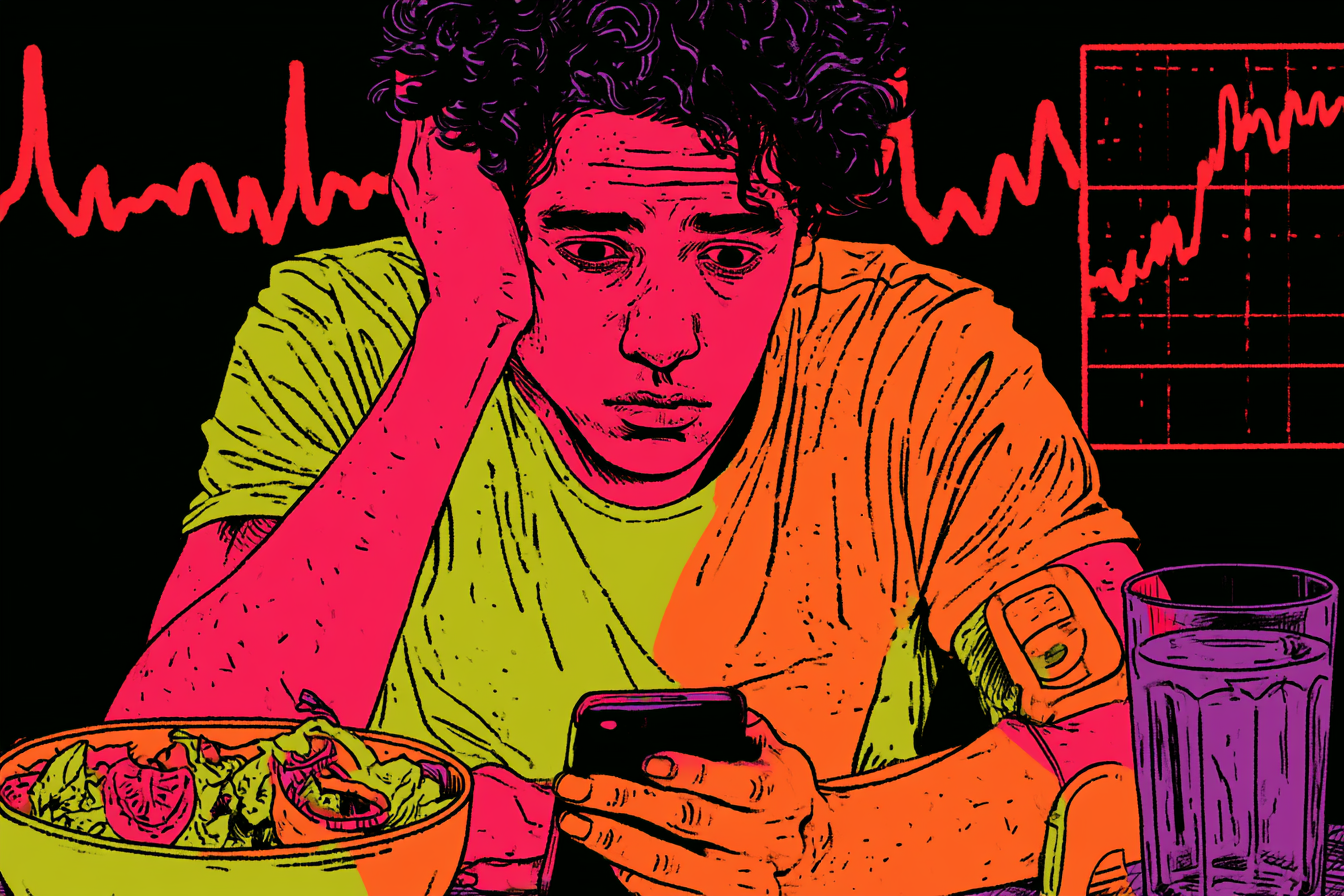
A continuous glucose monitor strapped to the arm of someone who does not have diabetes, turning an ordinary post-lunch rise into a personal emergency - followed, neatly, by the supplement or the membership that promises to flatten the curve you have just been taught to dread.
It is a closed circuit: manufacture the anxiety, monetise the reassurance. And it explains the other two completely. The equity and the advisory fees are only worth holding because the loop reliably pays out. The dread is the product. And once you're in that state, you'll buy almost anything to alleviate it.
The Means Siblings and the Capture of Public Health
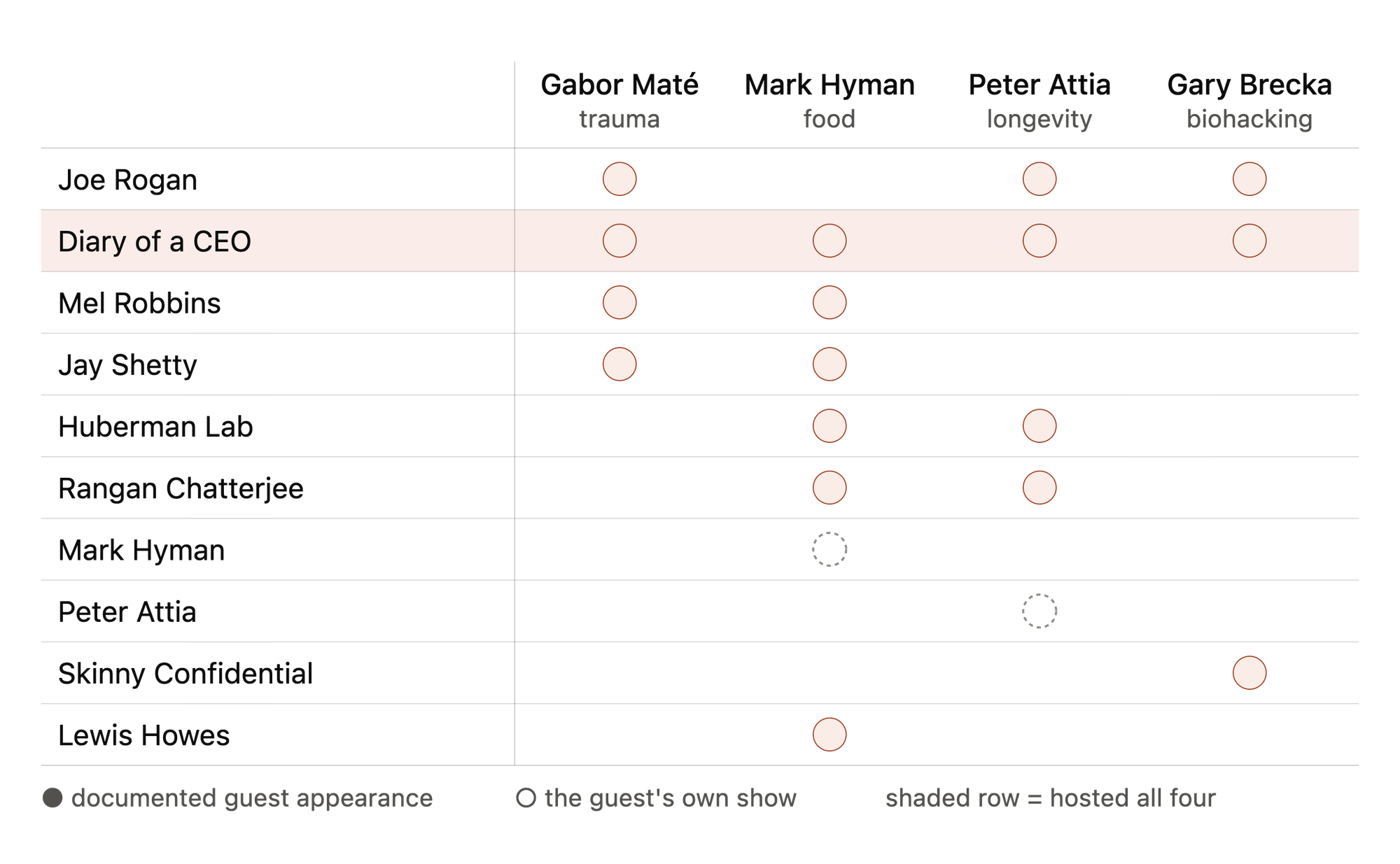
Watch the same faces long enough and you notice they are touring. A wellness claim does not travel on its own merits. It travels on trusted rooms. A small set of carriers move between shows that agree on almost nothing else - a conspiracy-friendly megacast here, a respectable GP's studio there, a business-podcast-turned-health-confessional in between - and they carry one identical message into each. The system is keeping you sick. The cure is not on the NHS, or covered by your insurance, or stocked by your GP. It is, happily, available.
The genius of the circuit is laundering. A claim that would sound deranged from a stranger on the street sounds plausible by the third time you have heard it, in a calm voice, from someone a host you trust has called brilliant. Respectability is not argued for. It is accumulated, one platform at a time, until a fringe idea has been rinsed through enough credible-seeming rooms to arrive in the mainstream wearing a clean shirt.
And the rooms know what they are doing. When BBC World Service fact-checked fifteen health episodes of The Diary of a CEO, it found not only an average of fourteen claims per episode that ran against scientific consensus, but a pattern beneath them: guests who insisted the establishment was hiding a simple cure, and who - the BBC noted - "often also advertised their products on the podcast."
The diagnosis and the merchandise arrive in the same breath. The American functional-medicine evangelist Mark Hyman tells Bartlett's audience that gluten can cause everything from osteoporosis to schizophrenia; the audience, newly frightened, is one click from a protocol.
 Matt Hussey
The purest specimen of the circuit is a brother and sister. Casey and Calley Means rose from near-anonymity by touring exactly these rooms - Rogan, then Carlson, the ideological poles of the podcast map - carrying one message between them.
Their interview with Tucker Carlson became, by Apple's own count, the most-shared podcast episode of 2024. Its title said the quiet part out loud: The Truth About Ozempic, the Pill, and How Big Pharma Keeps You Sick.
The thesis of the entire industry, printed on the most-shared episode of the year is there for anyone looking. Let me explain. Casey co-founded Levels, the glucose-monitoring app that turns a normal lunch into a number to fear; Calley founded Truemed, which exists to route tax-advantaged dollars toward supplements designed to complement the tests sold by Casey. One sibling sells you the worry. The other sells you the mechanism that funds the fix. The fear and the checkout are not merely on the same circuit. They are in the same family.
And then the circuit did something a supplement funnel is not supposed to be able to do. It kept going - past the checkout, and through a government door.
When Disclosure Stops Working
For most of this story, the remedy seems obvious. Make them say it. If a host owns the supplement, force him to disclose the stake, and let the grown-up listener weigh the words accordingly. Disclosure is the safety valve the whole system leans on - the thing that turns a conflict of interest into merely a declared interest. The Bartlett ruling worked exactly this way: the regulator did not ban the man, only the silence.
The Means siblings are the perfect example of what happens where that valve fails. Their tour did not end at a checkout page. It ended at the federal government. Casey Means was nominated by Donald Trump to be Surgeon General of the United States.
Calley, meanwhile, became a special government employee advising Robert F. Kennedy Jr at the Department of Health and Human Services. The two unknowns who, eighteen months earlier, had been touring podcasts with a message about a corrupt medical system were now inside the building, holding the pen.
 Matt Hussey
But disclosure relies on honestly. And the Means siblings didn't appear all that interested in that. Reviewing Casey Means's filings to the Office of Government Ethics, the watchdog Public Citizen found she had reported more than $450,000 in sponsorship and affiliate fees from wellness companies - many of which she also promoted to her followers, several of which she held a stake in.
And when it counted how often she had told those followers about the money, the answer was: not most of the time. She failed to disclose the financial relationship in 79 of 140 promotional posts - 56 per cent - a pattern a US senator, at her confirmation hearing, called "systemic."
But the disclosure failures, damning as they are, are not really the point. They are a symptom of the deeper problem, which is structural and does not improve even if every form is filled in perfectly. You can discount a podcaster for bias. You hear the ad-read, you note the equity, you adjust. But in the US, those same podcasters are now influencing policy.
High office has become less protector of the public, and more, superhighway for products. When the wellness circuit captures that office, it has not bought an advertisement. It has bought the referee.
This is the parallel to the Russian funding scandal I mentioned earlier. There, the corruption ran covertly through shell companies, and the danger was that hidden money might shape public opinion. Here there is nothing hidden and nothing foreign.
The money isn't hiding. Nor is in the influence. The cheque doesn't come from a shady government, it comes from you.
The Best Case for Wellness Podcasters, and Why It Breaks
It would be too easy to end this piece here. That this is a complex that has mastered exploitation and we shouldn't indulge in it. But there are elements inside all of this worth sitting with.
A case in point: the medical establishment they rail against is not a neutral arbiter of truth; it is an institution with its own captured incentives. In 2012, GlaxoSmithKline pleaded guilty and paid $3 billion - then the largest health-care fraud settlement in US history - for, among other things, misbranding antidepressants and paying kickbacks to the doctors who prescribed them.
Nutrition science has reversed itself within living memory, and not always honestly: we now know the sugar industry quietly paid Harvard researchers in the 1960s to publish reviews, later documented in JAMA Internal Medicine, that pinned heart disease on fat and waved sugar through - steering a generation of dietary advice in the process.
And the average NHS or insurance-rationed appointment is a rushed and frequently dismissive encounter; anyone who has sat across from a doctor who plainly stopped listening at minute three knows precisely the hunger the podcasters are feeding. People do not turn to a three-hour conversation about their own bodies because they are stupid. They turn to it because something real failed them first, and someone finally seemed willing to take the time.
And the long form format, something traditional television dumped in favour of 90-second segments, does offer far richer pickings than stripping out stories of their nuance to fit into a media package. The wellness industry did not invent the gap. It found one, gaping and unattended, exactly where the institutions had walked away. But, what they did with the gap is where the problem lies.
 Matt Hussey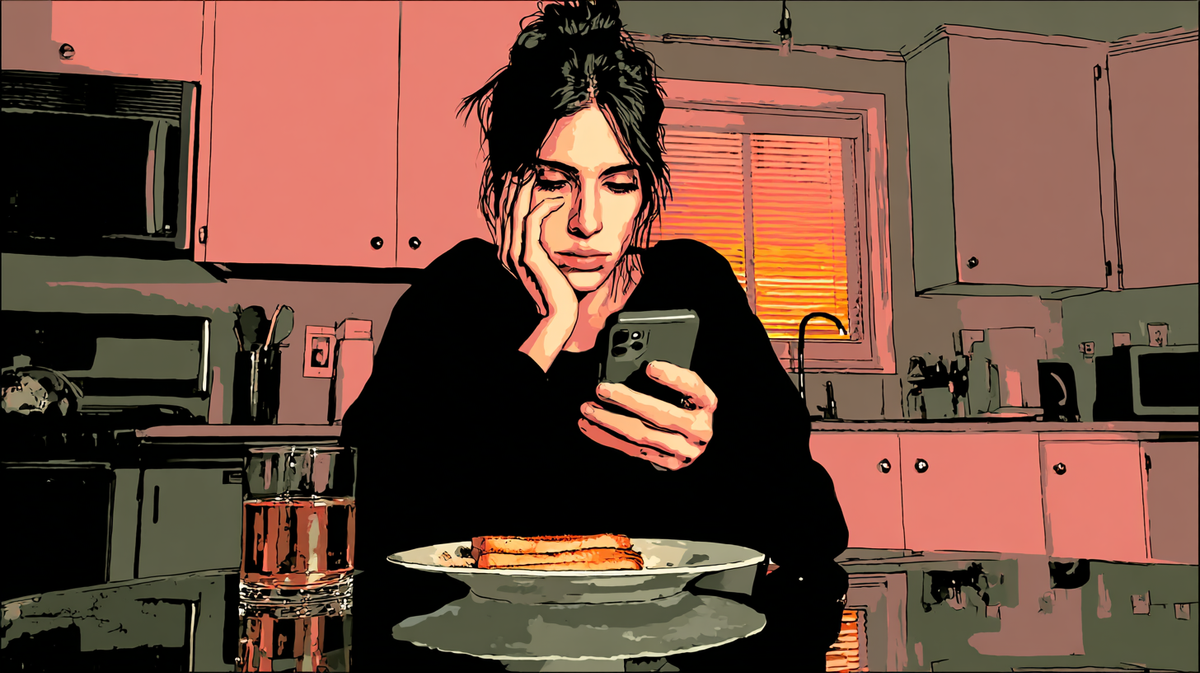
Because a real wound is not a licence to sell. It is the opposite - it is the thing that makes selling into it worse, not better. "The system is corrupt, so buy mine instead" is not a remedy for corruption. It is a change of ownership. It takes a person failed by an institution that at least had ethics boards, complaints procedures, regulators and the slow machinery of accountability, and routes them toward a market that has none of those things. The replacement is not less captured than the system it indicts. It is more captured, and it has removed any safety nets in the process.
As for the "audiences are adults" defence - the load-bearing plank of the whole argument - fails at the exact moment it matters most. Yes, a listener can discount a podcaster for bias. But the circuit's entire trajectory, as we have seen, is to convert bias into authority: to blur the lines between "you have been let down by the system" and "I have something from an entirely different, unregulated system to sell you". That is not a better system. It's a way worse one. Naming a captured system does not make you its cure. Often it just makes you its successor.
What Wellness Podcasts Are Actually Selling
So let's go back to the washing up for a moment. You, headphones in, tuned into the guy in the good lighting, the calm voice telling you that the tiredness and the low mood and the vague sense that your body is betraying you are not your fault - and, better still, are fixable.
That is the moment the whole machine is built around. And hey, it is a lovely moment. Someone is finally paying attention to you. Someone has a name for the thing, and a plan. After a decade of ten-minute appointments and being told your bloods are "normal" while you plainly do not feel normal, that attention lands like water on ground that has been dry a long time. The supplement was never the product. The supplement is what it costs you to be seen.
What is actually being sold is the feeling itself - the hope that there is a clean answer, the belief that someone finally sees you, the promise that agency is one purchase away. And that is a far more powerful thing to sell than powder, because you cannot overdose on it and you can never quite finish it.
A protocol or supplement stack that worked would end the relationship. So nothing is ever allowed to quite work. There is always a further optimisation, a new marker to track, a deeper layer of dysfunction to be lovingly diagnosed. The glucose was only the beginning. Have you considered your cortisol, your microbiome, your circadian light exposure, your seed-oil load? The journey, as they keep calling it, is designed never to end - because endings are an outcome that doesn't renew.
 Matt Hussey
This is the whole of Griftonomics, said plainly. It is an economy that has learned there is more money in the management of a problem than in its resolution, and it has applied that lesson to the human interior. It does not want you sick, exactly. It wants you maintained - permanently almost-well, permanently one protocol short, permanently subscribed. The anxiety is not a side effect of the business. The anxiety is the business.
And I keep coming back to who is actually on the other end of it. In the room where I work, I meet the people this machine has been through - the ones who arrive having spent two years and a great deal of money getting steadily more frightened of their own food, more estranged from their own bodies, more certain that wellness is a puzzle they are personally failing to solve.
They were not stupid. They were not gullible. They were in pain, and they were sold a story that took the pain seriously in exactly the way the system had not, and then quietly billed them for the taking-seriously, in monthly instalments, forever. The cruelty is not that the story was a lie. The cruelty is that it began with a truth -something is wrong, and no one is listening - and metabolised it into a subscription.
So, no. It is not a rebellion. Rebellions end. This one is structurally forbidden from ending, because the end is where the money stops. The men with the good lighting are not standing outside the system throwing rocks. They have built a better one - smoother, warmer, more personal, and entirely without exits. They took the establishment's oldest trick, the one where you profit from the thing you are meant to be curing, and they did what disruptors always do. They just made it more efficient.